
Description:
A “retention basin” is an area that is designed to store and retain a defined volume of runoff, allowing it to infiltrate and percolate through permeable soils or media into the groundwater. They are constructed or natural depression areas, often integrated into a site’s landscaping, where their bottom is typically flat, and turf, natural ground covers, or other appropriate vegetative or other methods are used to promote infiltration and stabilize the basin bottom and slopes.
Retention basins provide numerous benefits, such as reducing stormwater runoff volume, which reduces the average annual pollutant loading that may be discharged from the land. Additionally, many stormwater pollutants such as suspended solids, oxygen demanding materials, heavy metals, bacteria, some varieties of pesticides, and nutrients are removed as runoff percolates through the soil profile.
The capture percentage on an annual basis is dependent on the rainfall zone, the characteristics (DCIA and CN) of the catchment, and the size of the basin. The annual treatment effectiveness of all retention BMPs is directly related to the percentage of the average annual stormwater volume that is captured and not surface discharged.
Effectiveness was estimated for the volume of storage using simulations of runoff over at least 25 years. The capture design depth (inches) is calculated as the required treatment volume (RTV) of the basin divided by the watershed area with conversion factors (see Harper et al., 2007, 2016, and Wanielista and Yousef, 1993).
For most catchments, the maximum retention depth is no more than 4 inches because the annual capture is usually above 97% and the highest removal standard is 95%.

Input Data
There is one input parameter for retention: the provided retention volume. All other modifications to calculating the annual capture are already specified within the software, such as the meteorological zone, DCIA, and CN for the catchment.
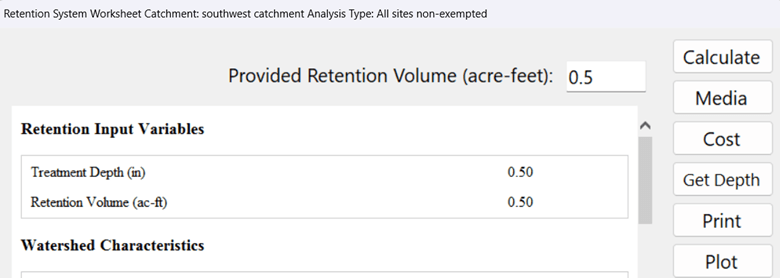
Treatment Depth (TD) Calculation
The retention treatment depth (TD) is calculated as the provided treatment volume (PTV) divided by the total catchment area (CA), multiplied by 12 inches per foot:
TD (inches) = PTV (acre-feet) × 12 inches/ft ÷ CA (acres)
- TD = treatment depth (inches)
- PTV = provided treatment volume (acre-feet)
- CA = catchment area (acres)
For this example, the provided retention volume is 0.5 acre-feet and the total catchment area is 12 acres. Thus:
0.5 ac-ft × 12 inches/ft ÷ 12 acres = 0.5 inches
For this example, the removal effectiveness is 63%.
Discovery Plot Example
To illustrate how the discovery aspects of the software are used, assume the performance standard specifies an 80% removal of phosphorus. The plot button is used to generate a discovery plot showing the change in effectiveness as a function of retention volume.
For this example (same catchment and no additional inputs between the two retention BMPs), the additional treatment depth required to achieve 80% removal is another 0.5 inches (1.0 inch − 0.5 inch).
Note that the addition of two separate effectiveness values (e.g., 63% and 63%) must not exceed 100%. The same pollutants cannot be removed twice, so the fundamental relationship shown below must be maintained.

Discovery plot illustrating effectiveness as a function of retention volume (vertical reference line must be retained).
Combined Removal Using Two Retention Basins
The calculation for overall removal (retention basin 1 + retention basin 2) cannot use the series equation of the Applicant’s Handbook, Volume 1 (June 28, 2024), page 9.7.

For example, for two basins in series where both are calculated at 63% removal, applying a series equation would produce:
− [(1 − 0.63) × (1 − 0.63)]
= 1 − (0.37 × 0.37)
= 1 − 0.137
= 0.863 or 86.3% (incorrect)
It is also certainly not the sum of both removals (63% + 63% = 126%), which is not physically possible.